
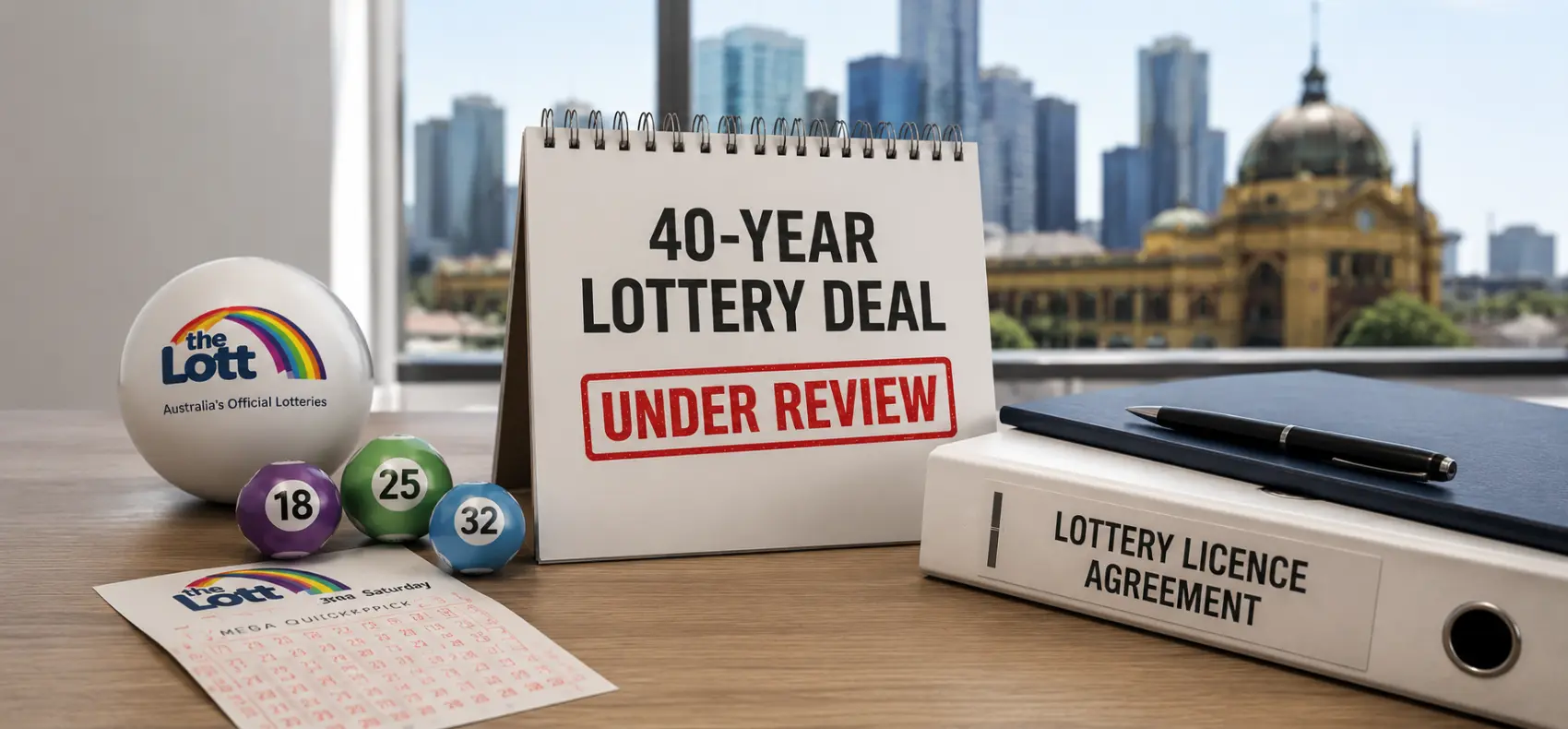
Victoria’s huge lottery licence deal with The Lottery Corporation is now facing a closer look from the state’s Auditor-General, after critics questioned whether taxpayers got the best possible value from a 40-year agreement struck without an open contest.
The Victorian Auditor-General’s Office has confirmed it will examine the public lottery licence extension announced in May 2026. The review will focus on whether the deal “optimised value for the State” — a dry phrase, but not a small question when the agreement runs until 2068 and carries an upfront premium of $1.145bn.
The Lottery Corporation’s Victorian subsidiary, Tattersall’s Sweeps, has held the state’s public lottery licence since 1954. Its existing 10-year agreement was due to expire on 30 June 2028, but the new extension gives the company exclusive rights to operate commercial lotteries in Victoria for another four decades.
That length is what turned a standard licensing story into a political fight. Victoria has historically used shorter lottery licence terms of around 10 years, while this agreement locks in the operator until 30 June 2068. For The Lottery Corporation, that creates certainty. For opponents, it raises a simple question: why so long, and why now?
Why the 40-Year Lottery Licence Is Under Scrutiny

The Auditor-General has not accused the government or the company of wrongdoing. Its published audit plan is careful and narrow. It says the process should have been backed by robust analysis and advice, and that a credible threat of competition should have been maintained during negotiations.
That last phrase matters. The deal followed exclusive, bilateral negotiations between the Victorian Government and The Lottery Corporation, rather than a public tender. In plain English: the government negotiated directly with the incumbent. That can be legitimate, especially where continuity and existing systems matter. But it also makes the value-for-money test harder to sell to the public.
A competitive tender gives rival bidders a chance to push the price higher or offer better terms. Without one, the government needs to show it still had enough leverage to land a strong deal. That is likely where the Auditor-General’s review will bite hardest.
The government’s side of the argument is easy to understand. A $1.145bn upfront payment is a large sum, and lottery duty provides ongoing revenue for state services. The Lottery Corporation also has a long operating history in Victoria, an established retail network and familiar brands. For a state looking at budget pressure, a clean, long-term agreement with the incumbent may have looked like a practical way to secure money without disrupting a product many Victorians already use.
The company’s side is just as clear. The Lottery Corporation gets long-term certainty in one of its key markets. According to iGaming Business, Victoria is its second-largest jurisdiction by lottery turnover and third-largest by EBITDA contribution, while company forecasts estimate nearly half of adult Victorians take part in its lottery games annually.
The market liked the certainty too. A 40-year licence removes a major renewal risk and allows the company to plan years ahead. The payment structure also gives the government fast cash, with iGaming Business reporting a $250m payment due in July 2026 and the remaining $895m due in October 2026.
What the Review Could Mean for Gambling Regulation

The political problem is not that lotteries exist, or that the state wants revenue from them. The problem is the optics. A long licence, a large upfront payment, a direct negotiation and a budget-day announcement make an easy target for opponents. The longer the agreement, the louder the question becomes: did Victoria trade future flexibility for money today?
Gambling reform advocates have also criticised the deal, not only for the process but for what it says about government dependence on gambling revenue. Lotteries are often viewed as a softer form of gambling than pokies or online betting, but they still rely on repeated consumer spending and jackpot-led marketing. When a state signs away a monopoly-style licence for 40 years, it is making more than an administrative decision. It is setting the shape of a gambling product for a generation.
That is why the Auditor-General’s review could matter beyond Victoria. Other Australian states also rely on gambling revenue while trying to present themselves as serious about harm minimisation. The balance is awkward. Governments regulate gambling, tax it, restrict parts of it, and then budget around the money it brings in. No wonder the public sometimes squints at the logic.
For players, nothing changes immediately. Lottery tickets will still be sold through familiar channels, and The Lottery Corporation will continue operating in Victoria. The review is about the deal-making behind the licence, not whether Victorians can buy a ticket this week.
For the government, however, the review keeps the story alive. A clean report would help it argue the agreement was commercially sound. A critical one could reopen questions about transparency, competition and whether the state gave away too much certainty too cheaply.
The Auditor-General plans to examine the Department of Treasury and Finance, the Department of Premier and Cabinet, the Department of Justice and Community Safety, and the Victorian Gambling and Casino Control Commission. That is a wide enough net to make the review more than a box-ticking exercise.
A 40-year gambling licence was never going to pass quietly. In politics, four decades is not long-term planning. It is practically geological time.