
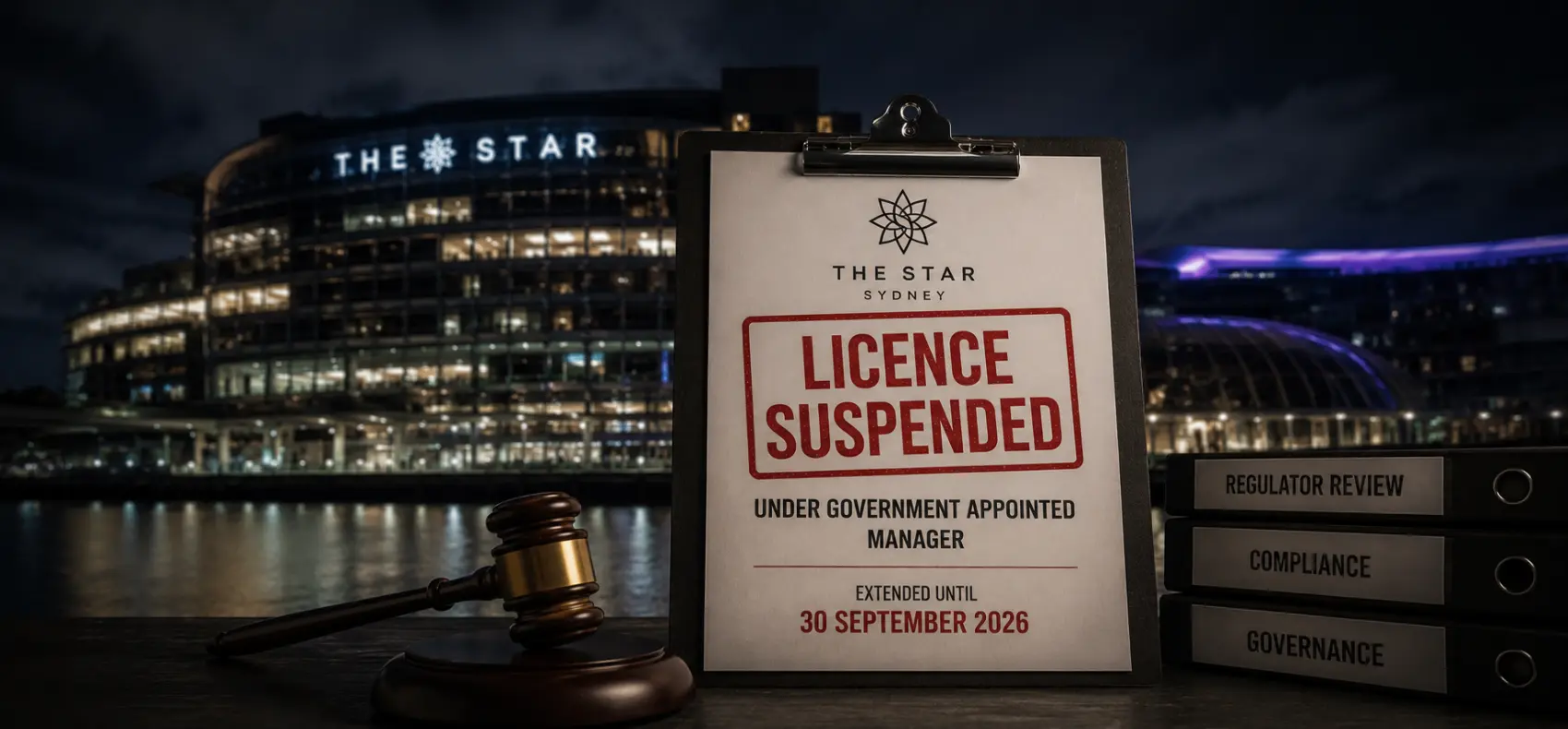
The Star Sydney will remain under outside control for at least another six months, after NSW authorities extended the term of the casino’s government-appointed manager until 30 September 2026.
The decision means The Star can keep operating gaming facilities, but not under normal conditions. Nick Weeks, the manager first appointed in October 2022, will continue to hold the licence while the casino’s own licence remains suspended.
For a venue that once sat near the top of Australia’s casino tree, that is a sharp place to be more than three years after the first Bell Review exposed serious failures. The doors are still open, the tables are still running, and the lights are still on. But the regulator has made it clear that The Star Sydney has not yet earned its way back to ordinary licence status.
The NSW Independent Casino Commission said the extension was made at its request, with Chief Commissioner Philip Crawford noting the regulator had been working with The Star’s new leadership team on what must happen before the casino can be found suitable again.
That wording matters. This is not a final punishment, but it is not a clean bill of health either. It is closer to probation with a very watchful supervisor.
Bell Review Fallout Still Shapes The Star Sydney’s Future
The Star’s licence was first suspended in October 2022 after the original Bell inquiry uncovered major anti-money laundering, governance and responsible gambling failures. The group was then hit by a second Bell inquiry, which found that despite some progress, the casino still had not fixed enough of the underlying problems.
In October 2024, the NICC fined The Star $15m and imposed new directions and licence conditions following the Bell Two findings. At the time, Crawford said the second inquiry had identified continuing compliance failures and operations that still fell “far short” of suitability. The regulator also pointed to weaknesses in governance, regulatory compliance, technology and risk management, including areas The Star had previously said it had remediated.
That is the uncomfortable part of the story for The Star. It is not enough to say the old problems are understood. The regulator wants proof that the systems, people and culture have changed enough to stop those problems returning.
The latest extension also comes during a wider reset inside the company. Inside Asian Gaming reported that The Star did not seek a formal licence determination in March 2026 and instead submitted a “pathway to suitability” plan. That approach suggests the company and regulator both know the job is not finished.
The business itself has also changed hands in practical terms. Bally’s Corporation and Investment Holdings Pty Ltd have taken a combined majority position in The Star, bringing new control, new pressure and a new attempt to stabilise the group after years of regulatory and financial damage. The NICC said the new owners are making “significant changes” to the business, including work aimed at making it more financially sustainable.
That financial point cannot be separated from the compliance story. A casino trying to rebuild its controls while also dealing with balance sheet stress is not in an easy position. Compliance programs cost money. New systems cost money. Stronger staff training, risk controls and reporting lines cost money. Cutting too hard in the wrong place can create exactly the weaknesses regulators are trying to remove.
At the same time, NSW cannot simply look away because a company is under financial pressure. The whole lesson from the Bell inquiries was that a casino’s internal culture and controls are not private housekeeping issues. When those controls fail, the consequences can spread into money laundering risk, criminal infiltration and gambling harm.
Why The Star Sydney Case Matters for Australian Casino Regulation

That is why The Star’s suspension has become more than a company-specific drama. It has become one of the central examples of Australia’s new casino regulation era. Crown, Star and state regulators have all been forced into a more serious conversation about what “suitable” actually means. A casino licence is no longer treated as something that simply rolls forward because the building is large, the staff numbers are high and the tax revenue is useful.
There is still a practical balancing act. The Star Sydney employs people, attracts visitors and sits inside a wider hospitality economy. Shutting it down completely would carry its own economic hit. Keeping it open under external control gives NSW a middle path: gaming continues, jobs remain, but the operator does not get the full trust of a restored licence.
For customers, the day-to-day difference may be hard to see. The casino is not closed. The bars, machines and tables do not come with a giant sign explaining the regulatory architecture above them. But behind the scenes, the message is blunt: The Star Sydney is still being watched because the regulator is not satisfied yet.
For the broader Australian gambling industry, that message should travel. Remediation is not a press release. A new board, a new chief executive or a new owner may help, but none of those things automatically rebuild trust. Regulators now want evidence that risk controls work in practice, that management understands the obligations, and that responsible gambling is not treated as a side department with nicer brochures than budget.
The next key date is 30 September 2026. By then, The Star will need to show the NICC that its pathway to suitability is more than a plan on paper.
Until then, Sydney’s biggest casino remains in a strange halfway house: open for business, but still not trusted to stand on its own.