
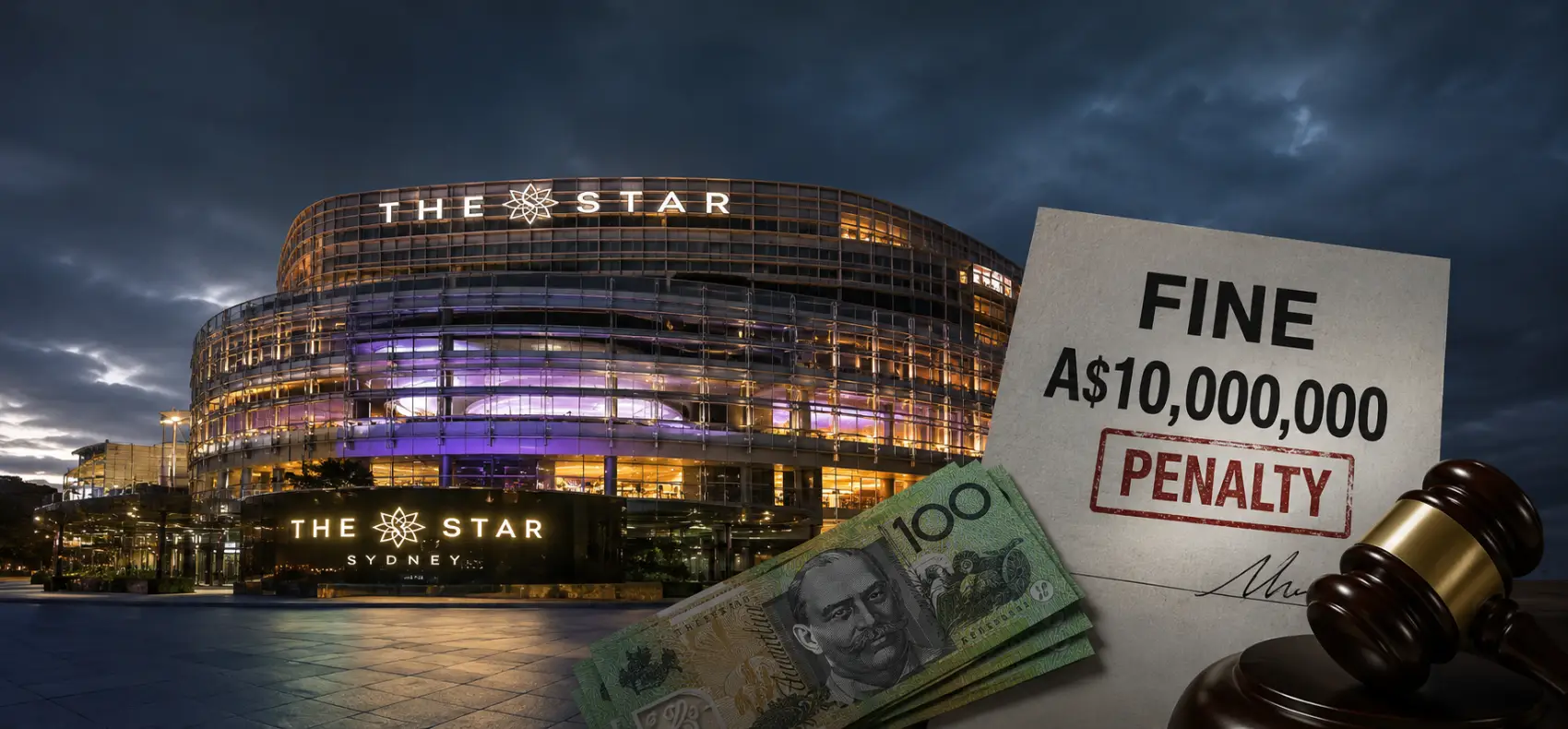
The Star Sydney has been hit with A$10 million in new fines, a sharp reminder that the casino’s long-running compliance clean-up is still not finished.
The NSW Independent Casino Commission issued the penalties after Liquor & Gaming NSW investigated thousands of breaches at the casino in 2025. The matters were grouped into four disciplinary cases, covering financial crime risk failures, time-play breaches, excluded patron failures and the conversion of casino reward points into cash.
The regulator has also accepted an enforceable undertaking requiring The Star to set aside another A$5 million for technology upgrades linked to financial crime risk management.
That is a fairly blunt message from the NICC: progress may be happening, but past failures still carry a price.
Financial Crime Controls Remain The Biggest Problem

The largest penalty, A$5 million, relates to systemic failures in financial crime risk operations between July 2023 and September 2025. According to the regulator, the problems included issues with customer risk ratings, enhanced due diligence for high-risk patrons and ongoing customer checks.
In some cases, the casino failed to properly assess whether a customer was at risk of being involved in criminal activity, including money laundering or terrorism financing. For a venue already under intense scrutiny after the Bell inquiries, that is exactly the kind of weakness regulators are no longer willing to treat as a back-office problem.
The remaining penalties show the breadth of the issues. The Star was fined A$1.5 million for allowing customers to gamble continuously beyond prescribed time limits between May 2024 and April 2025. The NICC said many of those breaches involved patrons gambling for more than 12 hours in a 24-hour period. In more serious cases, some were able to gamble for more than 36 hours straight.
That detail cuts through because it is not abstract compliance language. A 36-hour gambling session is a failure with a human shape. Rules around breaks are meant to interrupt harmful play before it becomes a marathon. If they are not enforced, the protection is just words on a policy page.
The Star was also fined A$3 million for allowing casino reward points to be converted into cash between December 2018 and November 2023. The issue involved at least 1,898 patrons, with the regulator saying “comp” dollars were used to reimburse airfares and other travel expenses.
Another A$500,000 penalty was issued after the casino failed to prevent an excluded patron from entering on nine occasions between February and May 2024. Exclusion orders are supposed to be one of the clearer lines in casino regulation. If a person is excluded, the venue should not be letting them back in.
NICC Chief Commissioner Philip Crawford said the disciplinary matters were disappointing, but also noted progress under The Star’s new leadership. He pointed to revised remediation workstreams, Bally’s Corporation’s expertise and technology uplift since the breaches occurred.
That acknowledgement matters. The regulator is not saying nothing has changed. It is saying the changes do not erase what happened.
Licence Suspension Keeps Pressure On The Star


The Star Sydney remains in a difficult middle ground. Its casino licence is still suspended, and the venue continues to operate under an NICC-appointed manager. It is open for business, but not trusted to stand on its own licence yet.
That arrangement has become one of the clearest signs of how Australian casino regulation has changed. Before the royal commissions and Bell inquiries, major casino operators could often rely on size, jobs and tax revenue to keep political pressure manageable. That era is over. Regulators now want evidence, systems and working controls, not polished statements about transformation.
The new fines also land while The Star is trying to stabilise its wider business. The company has been through rescue funding, asset sales, leadership changes and heavy regulatory pressure across several years. Every new penalty makes the turnaround harder to sell, even when the breaches relate to older conduct.
For players, the case is another reminder that casino compliance is not some distant corporate issue. It affects whether high-risk patrons are properly checked, whether excluded people are kept out, whether long gambling sessions are interrupted and whether the venue is protected from criminal infiltration.
For the broader industry, the lesson is just as plain. Remediation is not a finish line that operators declare for themselves. Regulators will keep testing whether the new systems actually work.
The Star may be making progress, and the NICC has recognised that. But the latest A$10 million hit shows the casino is still paying for years when too many controls failed at once.
The clean-up continues. So does the bill.