
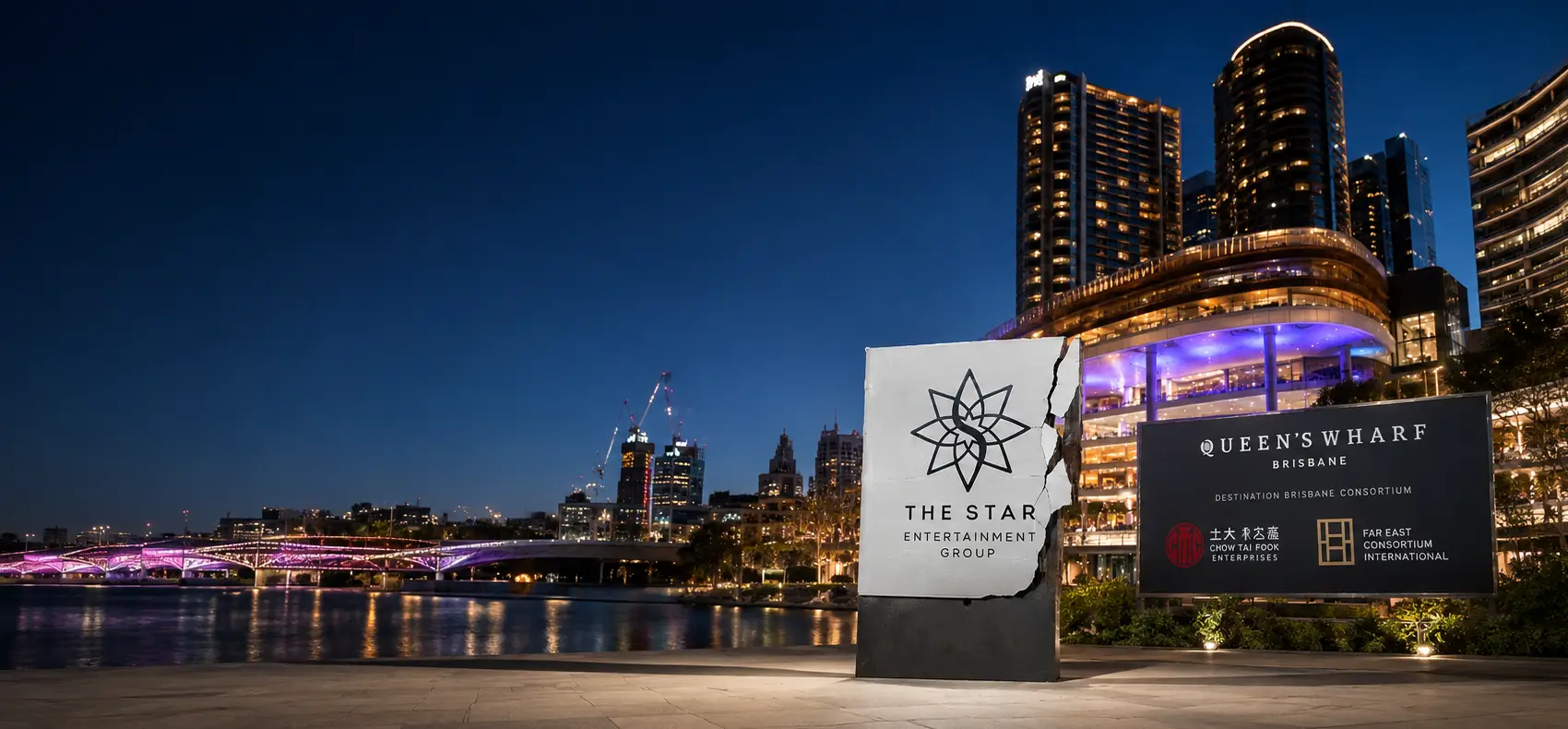
The Star Entertainment Group has completed its exit from Brisbane’s Queen’s Wharf precinct, handing full ownership of the city’s flagship casino resort project to its Hong Kong joint venture partners.
The move gives Chow Tai Fook Enterprises and Far East Consortium control of Destination Brisbane Consortium, the vehicle behind The Star Brisbane and the wider Queen’s Wharf development. The two companies previously held 25% each. After buying Star’s 50% interest, they now hold the project equally.
For Star, this is not just another asset sale. It is part of a broader attempt to simplify the business after years of regulatory pressure, financial stress and management upheaval. The company has spent much of the past few years trying to survive the combined weight of casino inquiries, fines, remediation costs, debt pressure and weaker trading conditions.
Queen’s Wharf was meant to be one of the jewels in the group’s portfolio. Instead, it became one of its heaviest burdens.
Queen’s Wharf Becomes a Costly Retreat

The Brisbane precinct opened in 2024 after years of construction and delays, with the integrated resort pitched as a major tourism and entertainment anchor for Queensland. The project was ambitious from the beginning: a CBD casino resort, hotels, restaurants, public spaces and residential towers tied into one of Brisbane’s biggest urban developments.
Ambition, however, is expensive. For a company already under pressure in Sydney and the Gold Coast, staying tied to a capital-heavy Brisbane project became harder to justify. Star’s ASX update said the completed first stage removes its interest in Destination Brisbane Consortium, while the second stage will cover remaining assets, including Destination Gold Coast Consortium and the Treasury Hotel in Brisbane.
The practical result is a cleaner split. CTFE and FEC take the Brisbane project. Star moves towards consolidating its position on the Gold Coast. It is less glamorous than a ribbon-cutting, but probably more useful to a company trying to stop the financial bleeding.
Star’s transaction documents also show why the deal matters beyond ownership percentages. The company is no longer required to fund further equity contributions for Destination Brisbane Consortium from 31 March 2025, and the ASX announcement noted that those contributions had otherwise been expected to be at least $212m. Star is also set to be released from its parent company guarantee relating to its 50% share of DBC’s debt facility, which had a drawn balance of $1.4bn.
Those numbers explain the logic. The sale may look like Star giving up a trophy asset, but trophies are not much use when they come with a debt schedule and a regulator breathing down your neck.
The Brisbane casino will not immediately become a completely different operation. Star has been expected to remain involved during a transition period while a replacement casino operator is identified and approved. The company’s ASX material says management of the integrated resort will transfer to a replacement operator once one is found and receives regulatory approval.
That transition will be closely watched. Casino ownership and casino operation are not always the same thing, but both matter to regulators, workers and customers. A new operator would need to satisfy Queensland authorities, and any handover would need to protect continuity at a venue that employs a large workforce and sits inside a major tourism precinct.
For Brisbane, the sale creates a strange mix of certainty and uncertainty. The ownership question is clearer now: CTFE and FEC are in control of the precinct. The operating question still has moving parts. A casino resort cannot simply be passed around like a hotel lease. Licensing, probity, responsible gambling controls, anti-money laundering systems and staff arrangements all need to line up.
Star Narrows Its Future Around Survival
For Star, the Brisbane exit is part of a much bigger narrowing of focus. The group is still dealing with the consequences of the Bell inquiries in NSW, continued regulatory supervision in Sydney, and a long-running effort to rebuild trust with governments and the public. The company’s survival story has involved asset sales, refinancing talks and new ownership influence, including backing from Bally’s Corporation and Investment Holdings.
The risk is that every move starts to look like emergency surgery. Sell an asset here, refinance there, cut costs somewhere else, and hope the patient keeps breathing. The better version of the story is that Star is finally becoming a smaller, more manageable business with fewer distractions and a clearer compliance task.
The difference between those two readings will show up over time.
If the Brisbane exit gives Star enough balance sheet breathing room to invest properly in compliance, governance and customer protection, it may prove to be a painful but necessary retreat. If it simply buys time without fixing the deeper problems, the company will be back in familiar territory: explaining to regulators and investors why the turnaround is still just around the corner.
For the Australian casino sector, the deal adds another chapter to a broader reset. The old model relied heavily on scale, premium tourism, high-value players and large property developments. The new model is being shaped by stricter regulators, more political scrutiny and less patience for governance failure.
Queen’s Wharf still has a future as a major Brisbane entertainment precinct, especially with the 2032 Olympics on the horizon. But it will no longer be Star’s future in the same way.
Star has stepped away from the Brisbane project it helped build. Now it has to prove that less can actually mean stronger.