
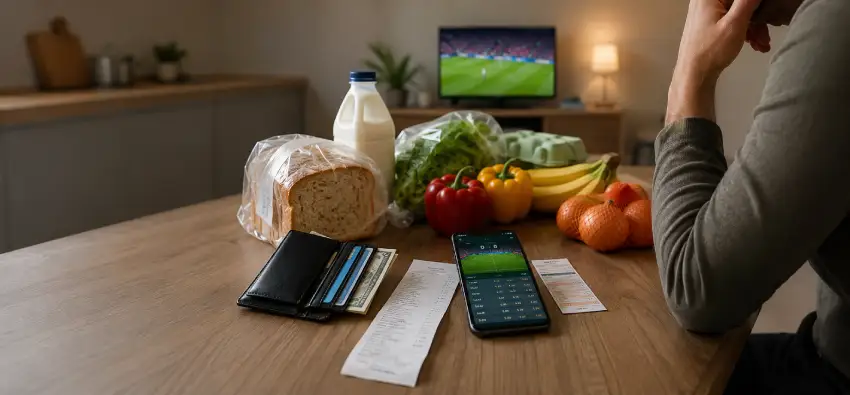
A new US study has put an uncomfortable question beside the World Cup betting boom: when sports wagering grows, what gets squeezed at home?
The National Bureau of Economic Research paper, Wagering the Bread Money: Sports Betting Legalization and Food Sufficiency, links sports betting legalisation with lower food sufficiency in US states where legal markets have opened. The researchers estimate that legal sports betting in nine states led to around 284,000 additional food-insufficient households and US$130.2 million in extra healthcare spending each year.
Betting Growth Comes With Household Costs

Food insufficiency is not just worrying about grocery prices. It means a household sometimes or often does not have enough to eat. That makes the finding sharper than a general “people are spending too much” warning.
The timing is hard to miss. The 2026 FIFA World Cup is already being treated as one of the biggest betting events in history. Legal US sportsbooks are expected to take billions in bets across the tournament, while global regulated wagering estimates are far higher. Operators are preparing for a month of football attention, sign-ups, promotions and live markets.
The NBER study is a reminder that betting growth does not only show up in operator handle and tax revenue. It can also show up in missed bills, tighter food budgets and household stress.
The researchers do not claim every betting dollar comes from grocery money. They also acknowledge the difficulty of proving a clean causal link, especially when the analysis relies partly on survey data and sits against a messy economic backdrop. Inflation, wages, rent, food assistance and other pressures all matter.
Even with those caveats, the finding is difficult to shrug off. If legal betting makes it easier to gamble often, and if some households then have less money for basics, regulators need to care about more than whether the market is licensed.
Why The Study Matters For Australia

For Australia, the study lands close to home. The local sports betting market is mature, heavily advertised and deeply tied to major sport. The federal government is already moving to tighten gambling advertising from 2027, especially around live sport and younger audiences. A study linking betting access to food pressure gives that debate another practical edge.
Most Australians do not think about gambling harm as a grocery issue. They think about addiction, debt, pokies losses or betting ads during footy. But harm often starts in ordinary places: a bill paid late, a smaller shop, a credit card used again, a partner not told the full story.
That is what makes sports betting different from a one-off flutter. Apps make it easy to bet repeatedly, quickly and privately. A person does not need to spend a night at a venue. They can lose money on a phone while standing in the kitchen.
Major events raise the risk because they bring in casual bettors as well as regular ones. A World Cup match feels like a social moment, and betting can be framed as part of the fun. Same-game multis, boosted odds and live markets all turn one match into dozens of small betting decisions.
For operators, that is good engagement. For some households, it may be another leak in the weekly budget.
The study also underlines why responsible gambling tools need to be more than decoration. Deposit limits, self-exclusion, affordability checks and early intervention matter most before someone reaches crisis point. A warning after the money is gone is not much of a safety net.
Australia does not need to copy US policy debates exactly. The markets are different. But the household pressure question travels easily. If gambling companies and governments benefit from rising sports betting activity, they also need to ask who is carrying the cost when the bet loses.
The World Cup will produce huge betting numbers. Operators will talk about engagement, market growth and customer excitement. Regulators will watch advertising and integrity risks.
This study adds a quieter measure: what happens at the checkout when betting becomes too easy.