
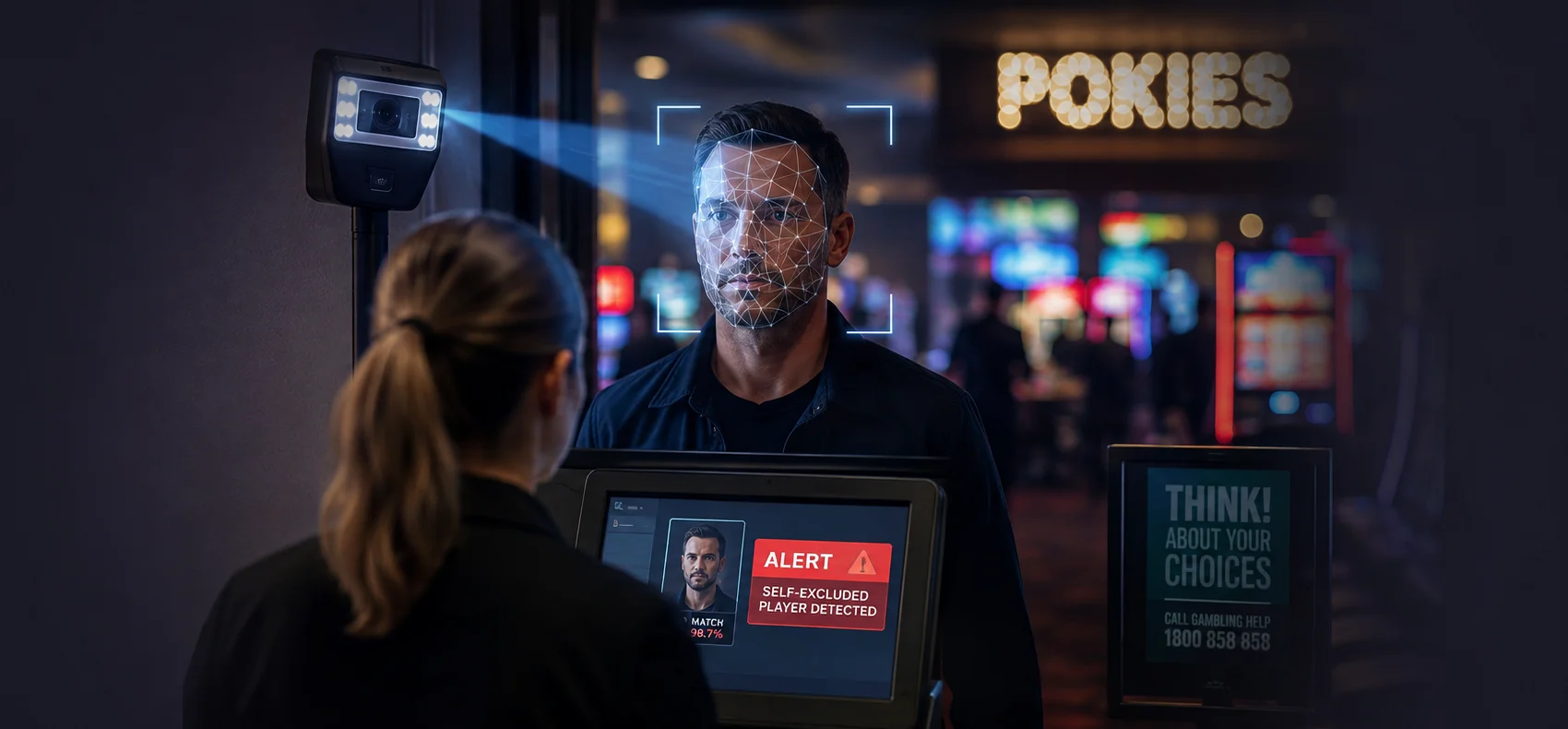
New South Wales has taken another step towards facial recognition in gambling venues, publishing a voluntary code of practice for hotels and clubs that use the technology to identify self-excluded players.
The code came into effect on 18 March 2026 and gives venues a set of minimum standards for using facial recognition technology, or FRT, in gaming areas. For now, it is voluntary. But the NSW Government has already made clear that this is an interim step towards mandatory FRT in hotels and clubs with gaming machines.
That makes the code more than polite guidance. It is a warning shot to the state’s pubs and clubs: if facial recognition is coming, operators need to start treating it like a serious compliance system, not a shiny gadget bolted onto the front door.
How Facial Recognition Could Change Self-Exclusion in NSW Venues

The basic idea is simple. Self-excluded players are people who have asked to be barred from gambling venues or gaming rooms because they are trying to manage gambling harm. In the old model, staff were often expected to identify excluded patrons by memory or by checking photos. In a busy club or hotel, that system has obvious limits. Faces change, staff rotate, gaming rooms get crowded and nobody can reasonably be expected to play human surveillance camera for an entire shift.
Facial recognition is being pitched as a fix for that weakness. A camera scans a person’s face and checks it against a database of excluded patrons. If there is a match, venue staff can be alerted and the person can be removed from the gaming area before they gamble.
Supporters argue that this gives self-exclusion programs actual teeth. A person who has taken the difficult step of excluding themselves should not be able to walk straight back into a venue because a staff member was busy, new or simply did not recognise them. Liquor & Gaming NSW has said the code is designed to support harm minimisation by improving the identification of excluded patrons.
But facial recognition in pokies venues also raises a very Australian problem: how much surveillance is acceptable in the name of safer gambling?
Privacy Rules Remain the Hardest Part of the FRT Debate

Biometric data is not ordinary customer information. A face scan is not the same as a membership number or an email address. If that data is collected, stored poorly or used beyond its original purpose, the consequences are harder to unwind. You can reset a password. You cannot reset your face, unless you are in a very different kind of news story.
That is why the NSW code focuses heavily on responsible data handling. Venues using FRT are expected to document how the system works, why it is being used, what data is collected, who can access it and how long it is kept. The code also expects venues to manage privacy, security and governance risks around the technology.
Legal commentary following the release has described the code as an attempt to balance harm minimisation with privacy and responsible data management. It also notes that licensed venues using FRT have operated in something of a grey area, with the new code giving clearer expectations for systems already in use or being considered.
That grey area matters because several venues have already been using facial recognition for self-exclusion or security purposes. A statewide framework reduces the risk of every operator making up its own rules. Without consistent standards, one club may keep data tightly controlled while another treats it like any other operational tool. In a sector handling sensitive gambling-harm information, that would be asking for trouble in fluorescent lighting.
The code is not yet legally enforceable in the way mandatory legislation would be. NSW Government guidance says venues cannot currently be penalised simply for breaching one or more requirements of the voluntary code. At the same time, the government “strongly encourages” compliance and has told venues already using FRT to take steps to align their systems with the code or create an implementation plan.
That puts clubs and hotels in an awkward but familiar position. They may not be legally forced to comply today, but they would be unwise to ignore the direction of travel. When a voluntary code is described as an interim step towards a mandatory system, it usually means the homework has been handed out early.
The wider context is NSW’s long-running pokies reform debate. The state has been under pressure to reduce gambling harm, improve self-exclusion, introduce stronger account-based play controls and address money laundering risks in gaming venues. Facial recognition sits inside that broader reform package, but it is not a magic answer on its own.
It can help identify excluded patrons. It cannot decide whether a person is gambling beyond their means. It cannot replace staff training. It cannot remove the need for serious intervention when harmful behaviour is spotted. And it cannot resolve the deeper question of whether NSW’s gaming machine footprint is simply too large.
Privacy advocates are also unlikely to be satisfied by assurances alone. In previous debate around biometric technology in gambling venues, critics raised concerns about accuracy, data security, misuse and independent oversight. The Guardian reported in 2024 that Clubs Australia had pushed for pokies venues to be exempt from some biometric data restrictions, while harm-reduction voices questioned whether facial recognition was the best tool compared with account-based or cashless systems.
For venues, the code is still a practical starting point. It gives operators a clearer idea of what government expects before mandatory rules arrive. For players, it signals that self-exclusion may become harder to bypass. For the public, it opens a debate that should not be rushed: safer gambling is a real goal, but biometric surveillance needs hard limits.
NSW has not solved that tension yet. It has simply put it in writing.