
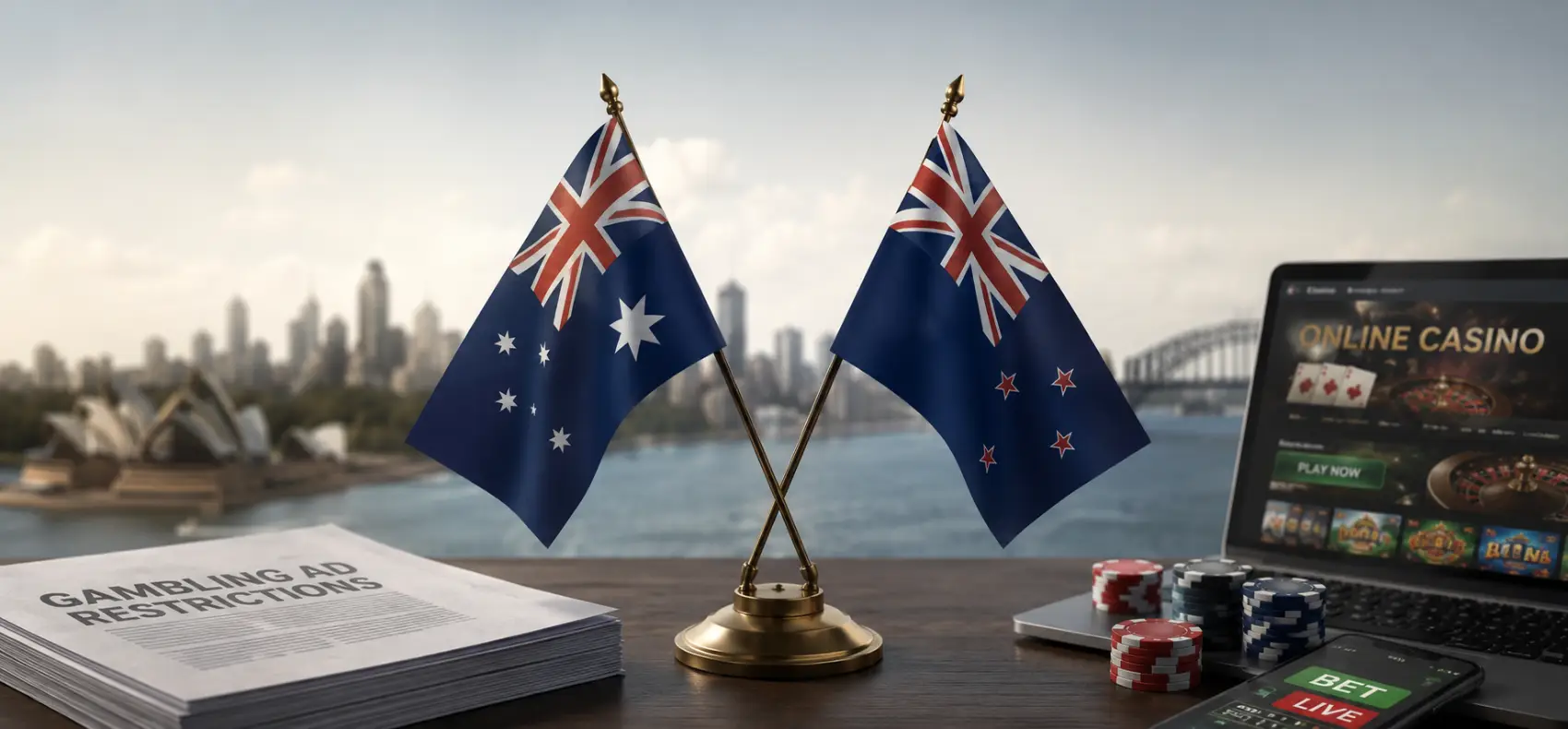
New Zealand is not rushing to copy Australia’s new gambling ad restrictions, choosing instead to focus on its incoming online casino licensing regime.
The Department of Internal Affairs has said it is watching Australia’s reforms, but wants to see how they work before considering similar rules at home. For now, the priority is getting New Zealand’s online casino framework moving, with up to 15 operators expected to be licensed under the new system.
That creates an interesting split between the two neighbours. Australia is tightening the screws on gambling ads while continuing to block illegal offshore casino sites. New Zealand is preparing to regulate online casino gambling, but it is not matching Australia’s broader sports betting ad crackdown yet.
Australia Moves Faster on Gambling Ad Controls

The timing makes the contrast sharper. Australia’s reforms, due to begin in 2027, include a cap of three gambling ads per hour on broadcast TV between 6am and 8.30pm, a ban during live sports in that window, tighter online ad rules and restrictions around celebrity endorsements, uniforms and stadium branding.
New Zealand is taking a slower line on sports betting ads. That does not mean it is going soft on gambling. Its online casino plan includes strict licensing, enforcement against unlicensed operators, a limited number of permits and new rules around casino advertising. The difference is where the government is spending its political energy first.
That choice makes sense in one way. New Zealand has an offshore online casino market that already exists outside local control. Players can access overseas sites, while the government has limited visibility over who is playing, how operators behave and what protections are being offered. Bringing that market into a licensed system is a large job on its own.
Still, the advertising question will not stay quiet for long.
Once licensed online casinos arrive, the pressure to control promotion will grow. A legal market needs visibility, or players may simply stay with offshore brands they already know. But too much visibility brings the same problem Australia is trying to fix: gambling becomes normalised through sport, media and online life.
That is the trap. If New Zealand restricts ads too heavily, licensed operators may struggle to compete with illegal sites. If it allows broad promotion, it risks turning regulation into a launchpad for online casino marketing.
Why Affiliate and Influencer Marketing Matter

The government is trying to avoid that by drawing harder lines around some channels. Paid influencer endorsements and affiliate marketing are expected to be banned under the online casino framework. That means licensed operators should not be able to rely on casino review sites, bonus-led affiliate pages or social media personalities to drive sign-ups.
That part is especially relevant to Australia. Offshore casino promotion here has already moved through softer channels: podcasts, YouTube mentions, social media posts and giveaways. These do not always look like gambling ads, which makes them harder for audiences to spot and harder for regulators to chase.
Traditional ad restrictions are easier to understand. A TV spot either runs or it does not. A logo is either on a jersey or it is not. Affiliate content is messier. It can look like a review, a guide, a ranking page or a casual recommendation. Influencer posts can disappear quickly, and the audience may remember the brand long after the story is gone.
New Zealand seems to understand that risk. It may not be copying Australia’s sports betting ad package, but it is not leaving casino marketing untouched. The country is trying to build a licensed market without importing the noisiest parts of the global online casino industry.
Australia’s reforms have their own critics. The Albanese Government’s plan falls short of the full ban recommended by the Murphy Report, and government modelling reportedly estimated the restrictions would reduce annual gambling spend by only 0.8%.
That figure gives New Zealand another reason to wait. If Australia’s reforms prove useful in reducing exposure and shifting public behaviour, Wellington may face pressure to follow. If they mostly cut visible ads without moving the harm needle, New Zealand may argue it was right not to rush.
For now, both countries are moving against the same problem from different angles. Australia is treating gambling advertising as the urgent political fight. New Zealand is treating online casino regulation as the bigger first step.
Neither path is easy. Australia still has to prove its ad rules will work across TV, sport, streaming, social media and apps. New Zealand has to prove it can legalise online casino without letting promotion spill everywhere.
The result will matter on both sides of the Tasman. If New Zealand can license online casinos while keeping advertising controlled, it will give Australia a live comparison. If the new market quickly becomes noisy, aggressive and bonus-heavy, Australia’s harder line will look easier to defend.
For now, New Zealand is watching Australia — but not following it.