
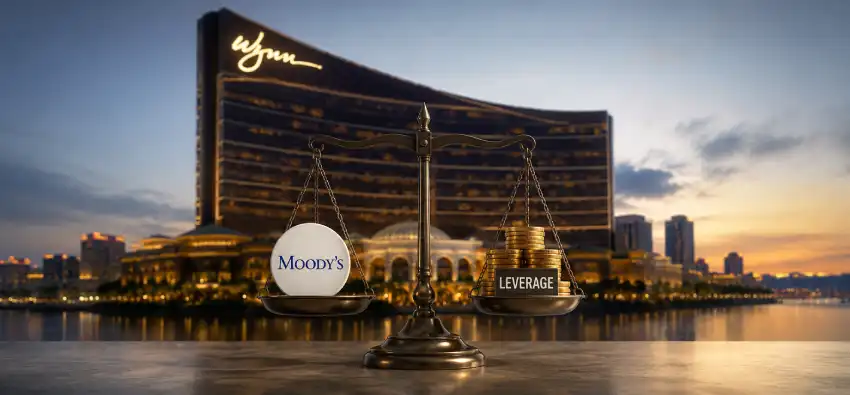
Moody’s has lowered its outlook on Wynn Resorts from positive to stable, a sign that the casino group’s recovery story still comes with a debt warning attached.
The ratings agency affirmed Wynn’s existing ratings, including its B1 corporate family rating, but said leverage remains higher than previously expected. Moody’s now expects Wynn to keep debt-to-EBITDA close to 6.0x, rather than moving clearly below that level.
That is the part investors will notice. Wynn’s operations have improved since 2025, especially as Macau continues to rebuild after the pandemic years, but the company is still carrying a balance sheet that leaves less room for error.
Moody’s pointed to Wynn’s strong liquidity as a positive. As of 31 March 2026, the group had $1.2 billion in unrestricted cash and cash equivalents, excluding $608 million in short-term investments. Much of that cash was held in Macau. Wynn also has access to large revolving credit facilities, including a $2.5 billion unsecured facility in Macau and a $1.25 billion secured revolver at Wynn Resorts Finance.
That gives the company flexibility. It does not remove the leverage problem.
Liquidity Helps, but Debt Still Sets the Tone

The stable outlook means Moody’s no longer sees a near-term upgrade path in the same way it did before. The agency still recognises the quality of Wynn’s resorts, the strength of its brand and the recovery of its Macau operations. But it also sees limited diversification and exposure to cyclical consumer spending as ongoing credit risks.
That last point matters for the whole casino sector. High-end resorts can look extremely strong when travel demand, premium spending and hotel rates are moving in the right direction. They can also feel the pressure quickly when consumer confidence softens or major projects require more capital.
Wynn is spending heavily on growth. In the UAE, the company is advancing the Wynn Al Marjan Island project in Ras Al Khaimah, where it holds a 40% stake. Wynn contributed $100.1 million to the joint venture in the first quarter of 2026, bringing life-to-date cash contributions to about $1.01 billion. The resort is expected to open in 2027.
In Macau, Wynn is also building The Enclave at Wynn Palace, a 432-key all-suite hotel project with an estimated budget of $900 million to $950 million.
Those projects give Wynn a stronger future pipeline, but they also explain why leverage is not falling as fast as Moody’s would like. Development spending can make sense strategically and still keep pressure on credit metrics.
Why Wynn’s Credit Pause Matters Beyond the US

For Australian readers, this is a useful global casino finance story rather than a direct local market update. Australian casino operators have spent the past few years dealing with licence issues, remediation costs and balance sheet pressure. Wynn’s situation is different, but the wider lesson is familiar: even strong casino brands have to prove they can fund growth without making the balance sheet too heavy.
The UAE project is especially interesting because it sits inside one of the world’s newest regulated gaming markets. Wynn is helping build that market from the ground up, while other operators and suppliers are watching closely. If the resort opens successfully, it could become a major new casino destination. If costs rise or the ramp-up is slower than expected, the financial pressure will be harder to ignore.
Macau is another key piece. The market has recovered, but operators are still adjusting to a new post-junket environment built more around premium mass, tourism and non-gaming investment. Wynn has strong assets there, yet Macau remains exposed to Chinese consumer trends, policy shifts and travel demand.
Moody’s decision does not suggest Wynn is in trouble. It suggests the upgrade story has paused.
The company has liquidity, major assets and improving performance. It also has elevated leverage and big projects still needing capital. For casino groups, that combination can work, but only while trading stays solid.
Wynn’s next task is simple to describe and harder to deliver: keep growing, finish the projects, and bring debt down enough for the credit market to believe the recovery has more room to run.