
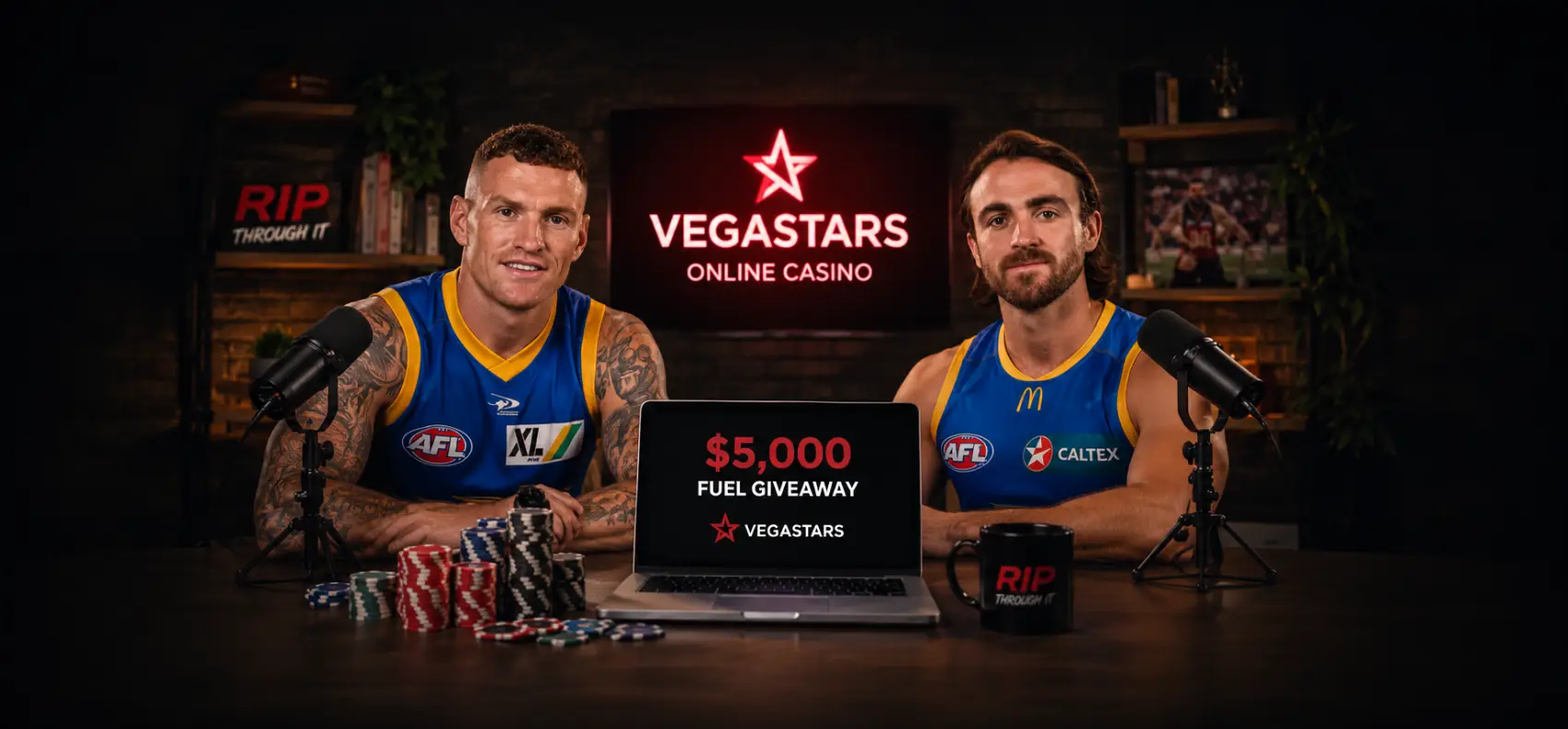
Two former Brisbane Lions players have been pulled into Australia’s illegal gambling advertising debate after being accused of promoting an offshore online casino to large social media audiences.
A Current Affair reported that Mitch Robinson and Rhys Mathieson promoted Vegastars, an offshore casino brand offering online casino-style gambling products that are not legal for Australian customers. The promotions allegedly appeared on the pair’s Rip Through It podcast and Robinson’s personal YouTube channel, and included a $5,000 giveaway tied to the operator.
The story cuts through because it is not about an anonymous account with a few hundred followers. Robinson played 247 AFL games before retiring in 2022, while Mathieson also built a profile at Brisbane. Both men have public platforms, and both have audiences that include young footy fans.
Why the Promotions Raised Legal Concerns

That is where the issue gets serious. Australia does not allow online casino products such as digital pokies, roulette and blackjack to be offered to local customers. Licensed sports betting sits in one bucket. Offshore casino-style gambling sits in a very different one. If it is targeting Australians, it is outside the legal market.
ACMA has already warned influencers that promoting illegal gambling services can carry heavy penalties. People who help provide access to illegal online gambling services can face civil penalties of up to $2.475 million per day, while corporations can face penalties of up to $12.375 million per day.
The Robinson and Mathieson case points to a wider problem. Offshore gambling brands have worked out that social media gives them a shortcut into Australian audiences. They do not need a TV campaign, a local licence or a bookmaker shopfront. A podcast mention, a YouTube clip, an Instagram story or a giveaway can do the job quickly, especially when the person promoting it already has trust with followers.
That trust is exactly why former athletes are useful to gambling brands. Fans do not see them as random advertisers. They see someone who played for their club, appeared on their screens and still lives inside the sport’s culture. When that person promotes a gambling site, the message can feel less like a paid ad and more like a tip from someone familiar.
That is dangerous territory when the product is illegal offshore casino gambling. Unlike licensed Australian operators, offshore sites do not sit under the same local consumer protections. If a player has a dispute, gets locked out, cannot withdraw winnings or gets caught by unclear terms, Australian regulators may have little practical leverage.
The giveaway angle makes the story messier. A $5,000 fuel-cost promotion sounds friendly enough on the surface, especially while many households are under cost-of-living pressure. But when the sponsor is an offshore gambling site, the soft packaging does a lot of work. It turns access to an illegal casino-style product into something that looks like a community freebie.
Alliance for Gambling Reform chief advocate Tim Costello criticised the alleged promotions, saying they were especially irresponsible given the influence former players can have over young men. News.com.au reported that Robinson and Mathieson had not responded publicly to the allegations at the time of publication.
Social Media Creates a New Challenge for Gambling Regulators

The AFL link also lands at a difficult time for sport. Australian codes already face criticism over the normalisation of betting through sponsorships, odds promotion and gambling advertising around matches. The federal government is moving towards tighter ad restrictions from 2027, including limits around live sport and bans on gambling branding in venues and on uniforms.
Former players promoting offshore casino brands adds another headache because it sits outside the neat world of official sponsorship deals. A league can control its broadcast partners and club policies more easily than it can control retired players with podcasts, YouTube channels and Instagram accounts. Influence does not retire when the player does.
ACMA has been trying to close the gap through website blocking and enforcement warnings, but blocking websites is only part of the fight. If offshore operators can keep finding public figures willing to point Australian audiences towards them, the block list becomes a slower tool. A site can be blocked, renamed, mirrored or promoted again through a fresh link.
For influencers and ex-athletes, the lesson should be clear. Before taking a gambling sponsor, public figures need to know whether the operator is legal in Australia, whether the product can be offered here, and whether the promotion itself could be seen as helping people access an illegal service.
The Robinson and Mathieson allegations have not ended in any public penalty, and no final finding has been announced against them. Even so, the episode shows how quickly illegal gambling promotion can move from fringe websites into mainstream sports audiences.
Australian gambling policy is already tightening around ads, offshore operators and consumer protection. Social media is the awkward frontier: faster than TV, harder to monitor than a stadium sign, and much better at making a gambling plug look like regular content.
The next wave of illegal gambling advertising may not look like an ad at all. It may look like a podcast chat, a giveaway, a quick YouTube mention or a familiar footy face telling followers where to play.