
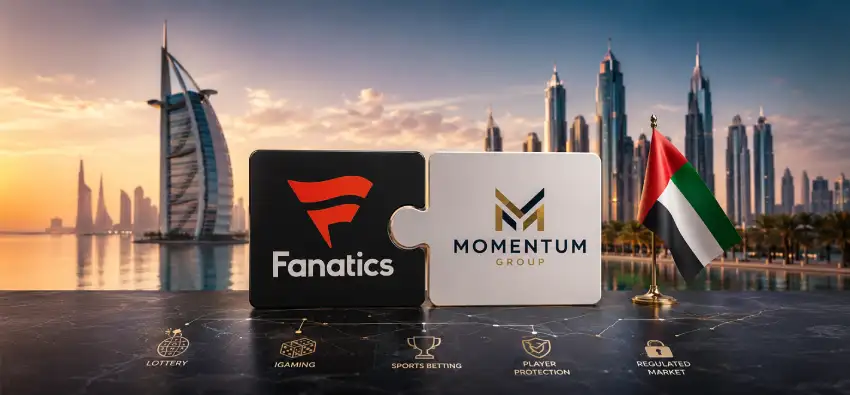
Fanatics has made its first move outside the US gaming market, launching a joint venture with UAE-based Momentum Group.
The deal brings together Fanatics’ product and technology with Momentum’s existing commercial gaming licences and operations in the United Arab Emirates. The country’s General Commercial Gaming Regulatory Authority has already approved the change of control for the licensed entities involved, including the UAE Lottery and Play971.
For Fanatics, this is a major step. The company has grown quickly in the US through sports merchandise, collectibles, betting and gaming, but international expansion has always looked like the harder test. The UAE gives it a young regulated market rather than a crowded mature one.
That is probably the attraction. Fanatics is not trying to fight for share in a market where every major bookmaker already has years of brand history. It is entering a market that is still being built.
Why Momentum Gives Fanatics a Local Advantage

Momentum Group is a strong local partner for that reason. It won the tender to operate the UAE Lottery in 2024, with the lottery launching later that year. Play971 then became the UAE’s first fully licensed iGaming business in 2025, before adding sports and race betting in June 2026.
The joint venture now gives both sides a broader platform. Momentum brings local market knowledge, regulatory relationships and licences. Fanatics brings customer technology, product experience and a wider sports ecosystem that already includes merchandise and fan engagement.
That combination could be powerful if it is handled carefully. The UAE is not trying to copy every other gambling market. Its regulated gaming sector is being introduced slowly, with strong emphasis on player protection, identity checks and controlled growth.
That cautious approach matters. The GCGRA was only established in 2023, and the country’s gaming market is still new by global standards. Wynn Resorts is building its Al Marjan Island resort in Ras Al Khaimah, while online gaming and lottery products are beginning to take shape under a strict licensing framework.
For Australian readers, the UAE story is useful because it shows another version of the channelisation debate. Australia is still focused on blocking illegal offshore casino sites and tightening gambling advertising. The UAE is doing something different: building a legal market from the ground up, with limited licensed operators and a strong regulator at the centre.
The goal is similar, even if the model is different. Both approaches try to pull players away from unregulated gambling. Australia does it mainly through prohibition and enforcement. The UAE is trying to create a regulated alternative early, before the grey market becomes too deeply embedded.
Sports, Regulation and Player Protection

Fanatics’ involvement also brings a sports-media angle. The company is not a traditional casino operator. Its wider business is built around fans, merchandise, collectibles and sports engagement. Adding gaming to that ecosystem can create a smoother customer journey, but it also raises the usual question: how close should betting sit to sport and fandom?
That question is already loud in Australia. The federal government is moving towards tighter gambling advertising rules from 2027, especially around live sport, celebrity endorsements and brand visibility. Regulators and campaigners are worried about betting becoming too normal inside the sports experience.
Fanatics will need to avoid that trap in the UAE. A young market can be shaped well or badly from the start. If gambling is introduced with visible safeguards, strict onboarding and clear responsible gaming tools, it can become a controlled entertainment product. If it becomes too closely tied to fan identity and constant sports engagement, the criticism will arrive quickly.
Momentum says player protection has been built into its products from the outset. The UAE Lottery and Play971 include deposit limits, time-outs and self-exclusion, while identity checks are used to verify customers and support anti-money laundering compliance. Legal age requirements also differ by product, with 18 for the lottery and 21 for iGaming and sports betting.
That kind of detail will matter as the market grows. New gambling jurisdictions often talk about responsible gaming at launch. The real test comes when operators start competing harder for customers.
For now, the joint venture gives Fanatics an international foothold and gives Momentum access to a major US sports and betting technology group. It also gives the UAE another signal that its regulated market is starting to attract serious global attention.
The UAE gaming sector is still small, but it is no longer theoretical. The lottery is live, Play971 is operating, Wynn is building, and Fanatics has now entered the room.
For a market that barely existed a few years ago, that is a fast start. The challenge is making sure it stays controlled while it grows.