
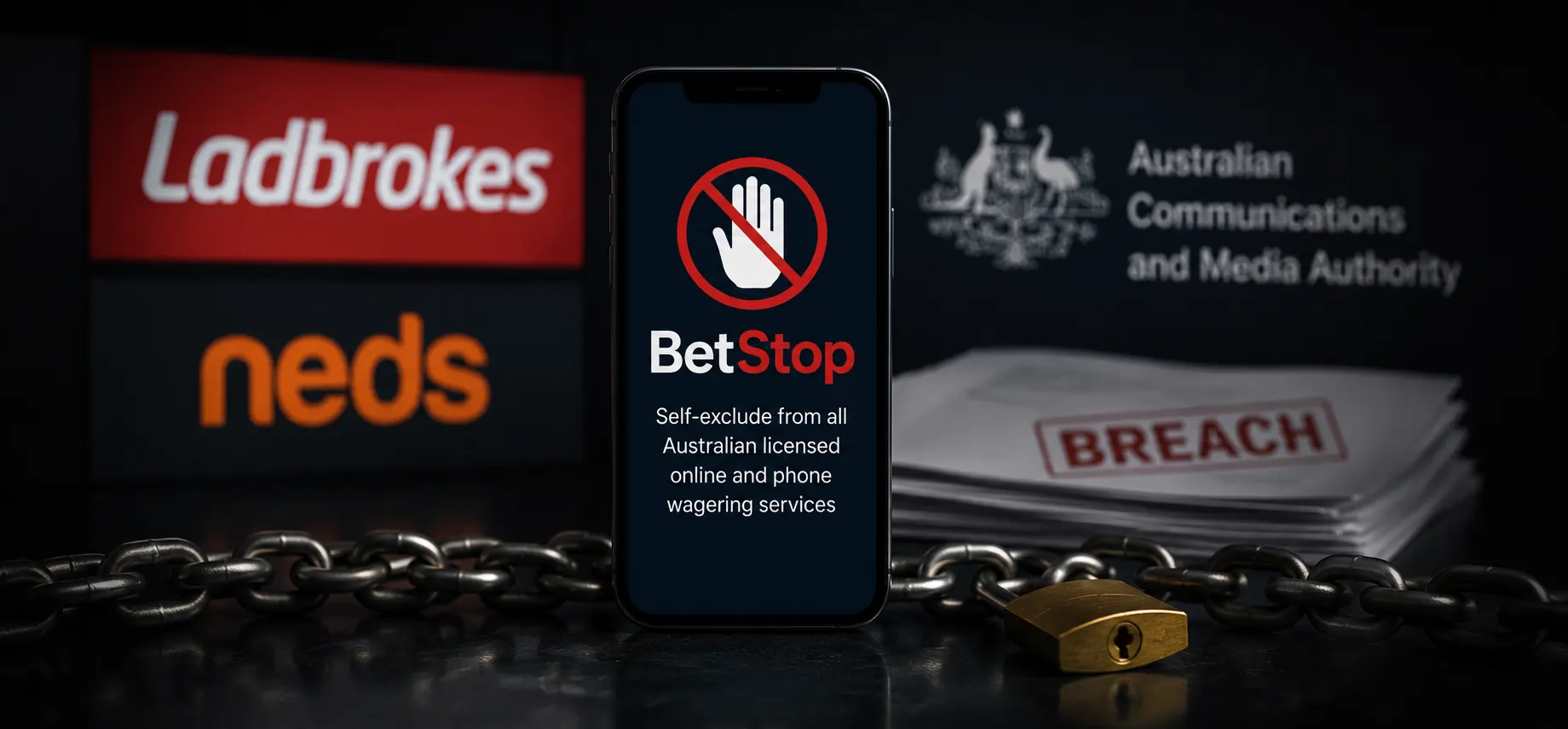
Entain has been pushed into an 18-month court-enforceable undertaking after Australia’s media and communications regulator found more than 500 breaches of national self-exclusion rules across Ladbrokes and Neds.
ACMA said the betting group opened accounts for people registered with BetStop, allowed some self-excluded customers to keep using wagering services, and failed to close existing accounts quickly enough. The regulator also found failures around promoting BetStop in customer texts and emails.
That is a messy result for any wagering operator. For Ladbrokes and Neds, it is worse because the whole point of BetStop is simplicity.
Why BetStop Failures Matter for Self-Excluded Players

The register was built so a person who wants to stop gambling can exclude themselves from all Australian licensed online and phone wagering services in one step. Once someone is on it, operators are not supposed to let them place bets, open new accounts or receive marketing messages.
There is not a lot of wiggle room there.
Self-exclusion is not a casual feature buried in an app menu. It is usually used by people who already know gambling has become a problem. By the time someone signs up, the “just gamble responsibly” line has probably stopped being useful. They are asking the system to put a wall in front of them.
In Entain’s case, ACMA says that wall had gaps.
Many of the breaches involved customers holding multiple accounts across the Ladbrokes and Neds services. According to ACMA member Carolyn Lidgerwood, Entain’s systems did not properly identify and link all wagering accounts held by those customers across its brands. One account stayed open for more than a year after the customer had self-excluded.
That detail is the one that should make the industry wince.
Modern betting operators know a lot about customers. They can segment players, serve promotions, track betting patterns, price risk and move quickly when a commercial opportunity appears. So when a self-excluded customer has more than one account inside the same corporate group, and the system does not join the dots, it is hard to sell that as a tiny technical hiccup.
It points to a bigger question: are gambling operators as good at blocking harmed customers as they are at finding active ones?
ACMA did not issue an infringement notice because that enforcement option was not available in these circumstances. Instead, it accepted a comprehensive 18-month enforceable undertaking from Entain. The company must conduct an independent review of its compliance systems and processes, then implement the recommended improvements. If it fails to comply with the undertaking, court-ordered financial penalties can follow.
That gives Entain a path to fix the problem without an immediate fine, but it also keeps the company under pressure. An enforceable undertaking is not a quiet handshake. It is a formal regulatory instrument with consequences attached.
The case also lands at a sensitive time for Australia’s wagering sector. BetStop only launched nationally in August 2023, after years of calls for a single self-exclusion system. Before that, players often had to exclude themselves operator by operator, which was about as practical as trying to stop rain with a spreadsheet.
The new system was meant to remove that friction. One registration, all licensed providers covered. ACMA says around 150 licensed wagering providers are included, and they must close betting accounts, block new accounts and stop marketing to excluded customers.
That promise is only as strong as the weakest operator system connected to it.
For players who are trying to stop, even one open account can matter. A person does not need access to ten betting brands to relapse. One account, one deposit and one bad night can be enough. That is why self-exclusion failures tend to hit harder than ordinary paperwork breaches. The harm is easy to understand.
What Operators Need to Fix After the Entain Case

Entain will now need to show its systems can recognise customers properly across brands, close accounts quickly and stop new accounts from slipping through. That means identity matching, account-linking, customer monitoring and internal escalation all need to work in the same direction.
It also means marketing teams cannot be treated as a separate universe. ACMA found Entain failed to adequately promote BetStop in some customer communications, which may sound like the smaller part of the case. It is not irrelevant. If a betting company can find room in an email or text for a promotion, the regulator expects it to make room for required safer gambling information too.
The wider industry should pay attention. Australia’s gambling reforms are moving towards tougher consumer protection, stronger enforcement and less patience for “systems issue” excuses. If licensed operators want to be treated as safer than offshore sites, they need to prove the protections actually work when a customer asks for help.
There is also a reputational problem here. Ladbrokes and Neds are big public-facing brands. They are not obscure operators with patchy infrastructure. If a major group can rack up more than 500 self-exclusion breaches, smaller operators will struggle to argue they should be trusted without close scrutiny.
None of this means BetStop has failed. A regulator finding and acting on breaches is part of the system doing its job. But it does show that the register alone is not enough. The real work happens inside operator databases, account checks, customer service teams and marketing systems.
For Entain, the next 18 months are now about repair. Not the press-release kind. The dull, expensive, necessary kind: matching records, closing gaps, testing controls, fixing processes and proving the same mistake will not keep happening.
BetStop was designed to make self-exclusion simple for Australians. Entain’s breaches show how quickly that simplicity can fall apart when operator systems do not keep up.