
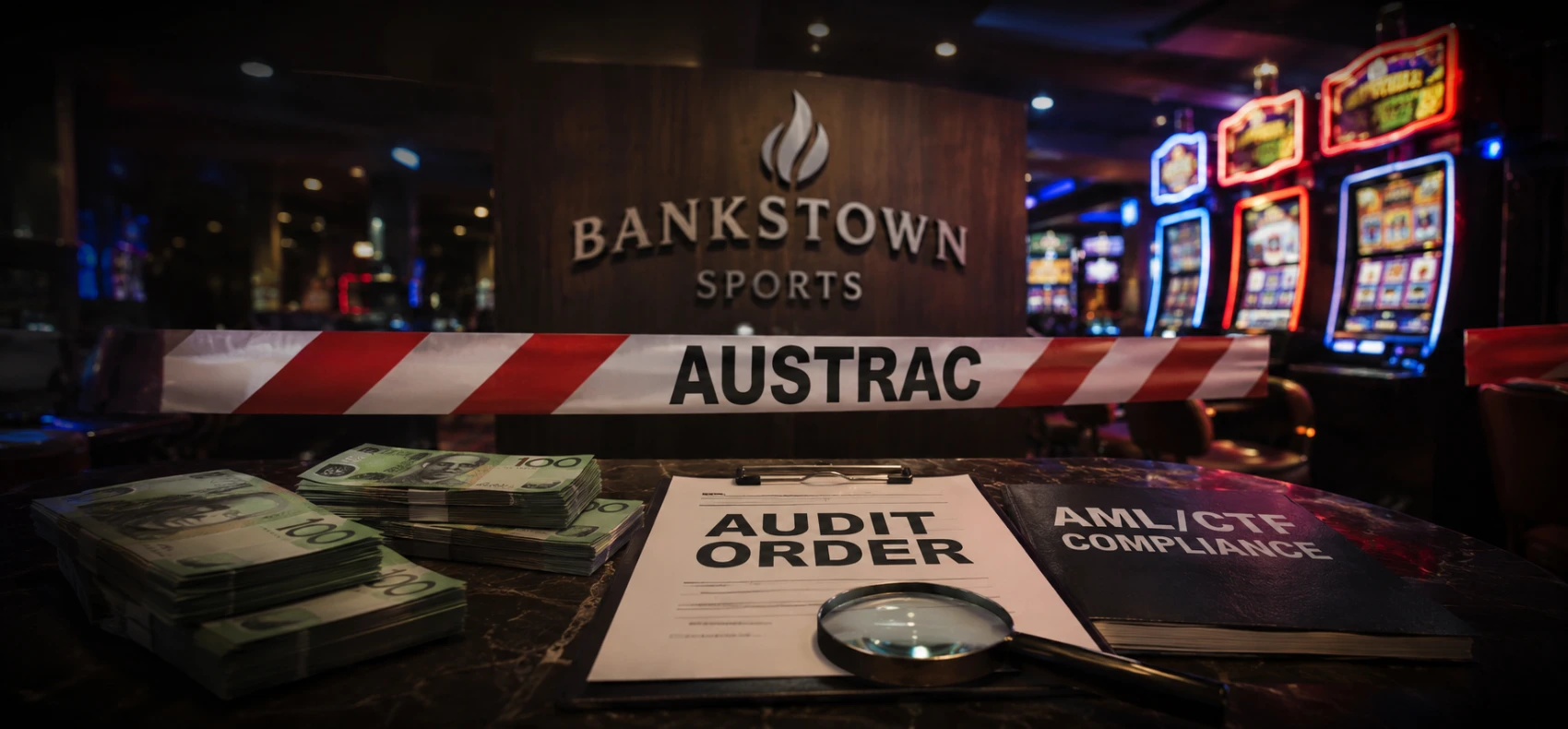
AUSTRAC has put one of NSW’s best-known clubs under the microscope, ordering Bankstown District Sports Club to bring in an external auditor over suspected weaknesses in its anti-money laundering controls.
The financial crime watchdog announced the order on 21 May, saying it has concerns the club’s systems may not be strong enough to stop criminals exploiting poker machines and gambling venues. The audit will be done at the club’s expense, with AUSTRAC setting the scope.
For NSW clubs, this is another loud warning in a year already full of them.
Why Poker Machines Create a Money Laundering Risk

The issue is not whether pokies can be misused. AUSTRAC is spelling out how they can be misused. Criminals can feed cash into machines, play little or not at all, then cash out and walk away with funds that look like gambling winnings. It is not clever. It is not glamorous. It is money laundering with carpet, flashing lights and a rewards desk nearby.
That is why the regulator is paying closer attention to clubs and pubs. They are not banks, but they still handle large amounts of cash. When poker machines are involved, a venue can become useful to criminals if staff miss warning signs or if monitoring systems are too weak to spot them.
AUSTRAC Acting CEO Katie Miller said clubs and pubs sit on the frontline of Australia’s fight against money laundering, especially where large volumes of cash and poker machines are involved. She said weak controls can allow criminals to turn illicit cash into funds that appear legitimate.
The order against Bankstown District Sports Club was made under section 162 of the Anti-Money Laundering and Counter-Terrorism Financing Act 2006. The auditor will examine whether the club has an effective, risk-based AML/CTF programme, whether it has properly assessed risks linked to its customers and services, and whether its monitoring systems can identify suspicious behaviour.
That sounds technical, but the practical question is simple: does the club know enough about what is happening on its gaming floor?
A venue with poker machines cannot rely on the idea that a player is just another customer pressing buttons. Some players are exactly that. Others may be moving cash in ways that should make staff ask questions. A strong compliance system is meant to separate ordinary gambling from patterns that look wrong.
The timing matters. AUSTRAC has been steadily widening its focus across Australia’s gambling sector, and clubs are now clearly part of that push. The regulator pointed to several other actions in the same announcement, including civil penalty proceedings involving Mount Pritchard District and Community Club, an enforceable undertaking with Sportsbet and an enforcement investigation involving Tabcorp.
That list is the real message. Casinos were first. Online bookmakers followed. Now pubs and clubs are getting the same treatment.
For years, the pokies debate in Australia has mostly focused on gambling harm: losses, addiction, late-night play, machine design and the role of clubs in local communities. Those issues have not gone away. But financial crime has moved into the foreground too, and it changes the conversation.
A club can no longer defend itself only by talking about jobs, sport sponsorships or community grants. If it runs gaming machines, it also has to show it understands cash risk, customer risk and suspicious behaviour. The “local community club” label does not give any venue a free pass.
Bankstown Sports has not been found to have breached the law in this matter. AUSTRAC has ordered an audit, not announced a penalty. The findings will help the club strengthen its compliance and help the regulator decide whether further action is needed.
Still, an external audit is not a friendly suggestion. It is AUSTRAC stepping in because it has seen enough to want an independent look.
What NSW Clubs Should Take From the AUSTRAC Order

For the wider NSW club sector, the lesson is obvious. The days of treating AML compliance as a folder on a shelf are over. Venues need working systems, trained staff, clear escalation processes and a proper understanding of how poker machines can be used by criminals.
The challenge is also cultural. Clubs are built around familiarity. Regulars come in. Staff know faces. Gaming rooms become routine. That can be good for hospitality, but dangerous for compliance. Familiar behaviour can still be suspicious behaviour. A customer who turns up often with cash, cycles through machines and cashes out with little genuine play should not be waved through because everyone knows their name.
AUSTRAC’s latest move also lands at a sensitive time for the industry. New AML/CTF reforms are tightening expectations across high-risk sectors, and gaming venues are under more pressure to prove they can manage risk rather than simply acknowledge it exists. Saying “we take this seriously” is the easy part. Showing the paperwork, the alerts, the reviews and the follow-through is where things get uncomfortable.
For players, the audit will probably not change a night out at Bankstown Sports straight away. The machines do not disappear because an auditor walks in. But behind the scenes, the venue will need to show whether its controls are fit for purpose.
For regulators, this is about more than one club. AUSTRAC wants to lift standards across the sector so gambling venues cannot be used to move or disguise criminal funds.
That is the line clubs should pay attention to. This is not a one-off inspection. It is part of a broader shift.
Pokies venues have already been under pressure over gambling harm, political influence and late-night losses. Now financial crime risk is sitting beside those issues. Not in the background. Right beside them.
Bankstown Sports is the latest name on the list. It is unlikely to be the last.