How to Play Craps Australia

02.06.2026
How to Play Craps Australia

Craps can look confusing when you first see the table. There are boxes, numbers, betting areas and casino terms everywhere, while the dice move quickly from one roll to the next. But the basic game is easier to understand once you focus on the main cycle: a shooter rolls two dice, a point may be set, and the round continues until that point appears again or a 7 appears first.

This guide is written for Australian readers who want a clear beginner explanation of craps. It covers the basic rules, key terms, the come-out roll, point numbers, Pass Line and Don’t Pass bets, common bet types, beginner mistakes, bankroll tips and responsible gambling.

It is educational only and does not promote offshore online casino play. Craps is still gambling, and even simple bets carry risk.


How Does Craps Work?

Craps is a dice game played with two six-sided dice. One player, called the shooter, rolls the dice, while players can bet on what will happen during the round.

  • The simplest version works like this:

    The simplest version works like this:

    • the shooter makes a first roll called the come-out roll;
    • if the come-out roll is 7 or 11, Pass Line wins;
    • if it is 2, 3 or 12, Pass Line loses;
    • if it is 4, 5, 6, 8, 9 or 10, that number becomes the point;
    • after a point is set, the shooter tries to roll that same point again before rolling a 7.
    • the shooter makes a first roll called the come-out roll;
    • if the come-out roll is 7 or 11, Pass Line wins;
    • if it is 2, 3 or 12, Pass Line loses;
    • if it is 4, 5, 6, 8, 9 or 10, that number becomes the point;
    • after a point is set, the shooter tries to roll that same point again before rolling a 7.

That is the core of craps. Once you understand the come-out roll and the point, the rest of the table becomes much easier to read.

What Is Craps?

Craps is a casino dice game built around the outcome of two dice. The person rolling the dice is called the shooter, but the shooter is not the only person involved. Other players can place bets on the shooter’s roll, the final result of the round or specific dice combinations.

The game is popular partly because it feels social. At many craps tables, several players bet with the shooter, so a strong roll can create a lively table atmosphere. That energy is one reason craps feels different from quieter casino games.

For beginners, the key is not to learn every bet at once. Start with the come-out roll, the point and the Pass Line. After that, the rest of the layout becomes easier to understand.

Red dice and casino chips on a craps table

Key Craps Terms

  • Craps has a lot of slang, but beginners only need a few terms at the start.

    Craps has a lot of slang, but beginners only need a few terms at the start.

    • Shooter — the person rolling the dice.
    • Come-out roll — the first roll of a new round.
    • Point — the number set when the come-out roll is 4, 5, 6, 8, 9 or 10.
    • Natural — a come-out roll of 7 or 11.
    • Craps numbers — 2, 3 or 12 on the come-out roll.
    • Seven-out — rolling a 7 after the point is set, before the point is repeated.
    • Pass Line — the main bet that wins when the shooter succeeds.
    • Don’t Pass — the opposite-style bet that wins when the shooter fails after a point is set.

You do not need to memorise every casino term before learning the game. These basics are enough to understand a standard round.

How a Craps Round Works

  • A craps round begins with the come-out roll. This first roll decides whether the round ends immediately or whether a point is established.

  • If the shooter rolls 7 or 11 on the come-out roll, Pass Line bets win. If the shooter rolls 2, 3 or 12, Pass Line bets lose. If the shooter rolls 4, 5, 6, 8, 9 or 10, that number becomes the point.

  • Once the point is set, the round changes. The shooter keeps rolling. The goal for Pass Line players is for the shooter to roll the point again before rolling a 7. If the point appears first, Pass Line wins. If 7 appears first, Pass Line loses.

  • This is why the number 7 matters so much in craps. On the come-out roll, 7 can be good for Pass Line. After the point is set, 7 becomes the number Pass Line players do not want to see.

The Craps Round in Simple Steps

  • Here is the same idea in a compact flow:

    Here is the same idea in a compact flow:

    A new round begins.
    The shooter makes the come-out roll.
    A 7 or 11 wins for Pass Line.
    A 2, 3 or 12 loses for Pass Line.
    A 4, 5, 6, 8, 9 or 10 becomes the point.
    The shooter keeps rolling.
    If the point repeats before 7, Pass Line wins.
    If 7 appears before the point, Pass Line loses.

This simple flow is the foundation of craps. Most beginner confusion comes from trying to learn every side bet before understanding this round structure.

Main Craps Bets Explained

Craps has many betting options, but beginners do not need to use every part of the table. The easiest way to learn is to start with the main bets, understand how they connect to the round, and only then look at faster or higher-risk options.

The sections below explain the most common craps bets in beginner-friendly terms.

Main craps betting areas with dice and chips

Pass Line Bet

  • The Pass Line bet is the most common starting point for beginners. It is a bet that the shooter will either win immediately on the come-out roll or make the point before rolling 7.

  • On the come-out roll, Pass Line wins on 7 or 11. It loses on 2, 3 or 12. If a point is set, the bet waits until either the point repeats or 7 appears.

  • Pass Line is popular because it follows the natural rhythm of the game. When most people at the table are cheering for the shooter, they are often backing Pass Line-style outcomes. The Pass Line bet is commonly listed with a house edge of around 1.41%, which is one reason it is often treated as a beginner-friendly craps bet.

Don’t Pass Bet

Don’t Pass is the opposite side of the basic round. It wins when the shooter fails after a point is set, but the come-out roll has its own rules.

  • In simple terms:

    In simple terms:

    • Don’t Pass usually wins on 2 or 3 on the come-out roll;
    • it usually loses on 7 or 11;
    • 12 is commonly a push, depending on table rules;
    • if a point is set, Don’t Pass wins if 7 appears before the point.

Mathematically, Don’t Pass is often a strong bet. It is commonly listed with a house edge around 1.36%, slightly lower than Pass Line.

The social side is different, though. Don’t Pass is sometimes called “betting wrong” because it wins when many players at the table lose. That does not make it a bad bet, but it explains why some players prefer Pass Line.

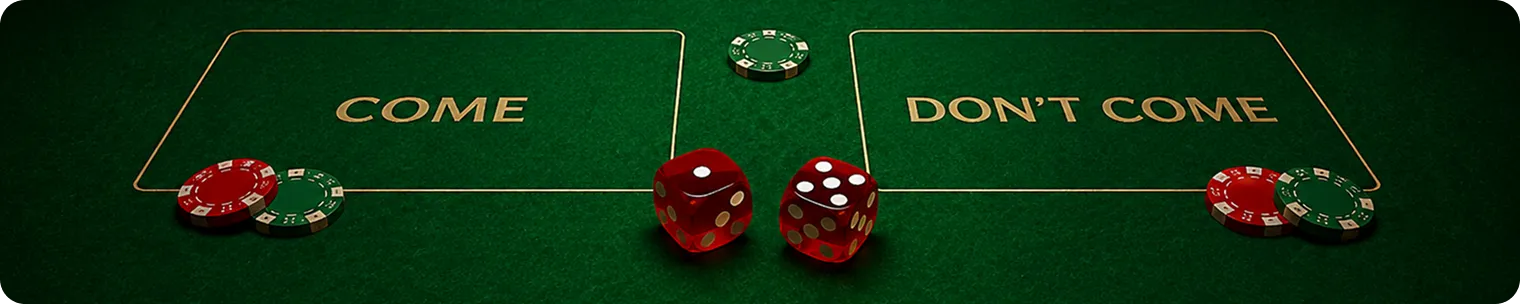
Come and Don’t Come Bets

Come and Don’t Come bets work a lot like Pass Line and Don’t Pass, but they are made after a point has already been established.

A Come bet acts like a fresh Pass Line bet starting from the next roll. If the next roll is 7 or 11, the Come bet wins. If the next roll is 2, 3 or 12, it loses. If another number is rolled, that becomes the Come point for that bet.

Don’t Come is the opposite version. It follows a similar logic to Don’t Pass, but it starts after the main point is already active.

Beginners do not need to rush into Come and Don’t Come bets. They make more sense once the basic Pass Line round is clear.

Come and Don’t Come bets with dice and chips

Pass Line vs Come Bet

  • Pass Line and Come bets are similar, but the timing is different.

    Pass Line and Come bets are similar, but the timing is different.

    • Pass Line starts on the come-out roll.
    • Come bet starts after a point has already been set.
    • Pass Line follows the main shooter’s point.
    • Come bet can create its own separate point.
    • Both are based on the same basic idea: win with the point before 7 appears.

A simple way to think about it: Pass Line is the main round. A Come bet is like starting a mini Pass Line bet inside that round.

Field Bet

The Field bet is a one-roll bet. It wins or loses on the very next roll, which makes it easy to understand but also fast-moving.

A Field bet usually wins if the next roll is 2, 3, 4, 9, 10, 11 or 12. It usually loses if the next roll is 5, 6, 7 or 8. Some tables pay extra on 2 or 12, and that payout rule can change the value of the bet.

This is important: Field is not automatically good or bad just because it is simple. The payout rules matter. A table that pays better on 2 or 12 can change the house edge compared with a weaker Field payout.

For beginners, Field can be easy to recognise, but it should not replace understanding the main round.

Place Bets

Place bets let you choose a number and bet that it will appear before 7. Common place numbers are 4, 5, 6, 8, 9 and 10.

Place 6 and Place 8 are often popular because 6 and 8 appear more often than 4 and 10. But the payout still matters. Higher-probability numbers usually pay less, while harder-to-hit numbers pay more.

  • Useful beginner points:

    Useful beginner points:

    • Place 6 and 8 are common because they roll more often than 4 and 10.
    • Place 4 and 10 pay more, but appear less often.
    • Place bets lose if 7 comes before the chosen number.
    • Place bets are easier to understand after learning the point system.

Place bets are not required for a beginner. They are better treated as a second step after Pass Line is understood.

Odds Bets

  • An Odds bet is an extra bet that can be placed behind a Pass Line or Come bet after a point is established. It wins if the point appears before 7.

  • The unusual thing about Odds is that it pays true odds, meaning there is no built-in house edge on the Odds portion itself.

  • That does not mean the full situation is risk-free. You still need the original Pass Line or Come bet, and the combined amount can increase your total exposure. For beginners, Odds are worth learning, but they should still fit your budget.

Big 6 and Big 8

Big 6 and Big 8 are simple-looking bets. You are betting that 6 or 8 will roll before 7.

The problem is that these bets are often worse than placing the 6 or 8 directly. They may look easy on the layout, but the payout can be weaker.

That is a common craps lesson: the easiest-looking bet is not always the best-value bet. Before placing extra bets, check whether there is a better-paying version of the same idea elsewhere on the table.

Big 6 and Big 8 craps bets with dice

Prop Bets and Centre Bets

  • The centre section of a craps table usually contains proposition bets. These are bets on very specific outcomes, often resolved in one roll.

  • Examples include bets on Any 7, Any Craps, specific doubles or exact combinations. They can look exciting because the payouts may be much higher than basic bets.

  • The trade-off is risk. Many prop bets have a higher house edge than Pass Line or Don’t Pass. For beginners, they are better treated as high-risk extras rather than a main strategy.

    If you are still learning craps, the centre of the table is usually not the best place to start.

Lower-Risk Craps Bets for Beginners

No craps bet is guaranteed, but some bets are easier to understand and generally more efficient than others.

  • Beginner-friendly starting points often include:

    Beginner-friendly starting points often include:

    • Pass Line;
    • Don’t Pass;
    • Come bets after learning Pass Line;
    • Odds bets after understanding the point;
    • Place 6 and Place 8 as a simple next step.

High-payout bets can be fun to watch, but they usually come with more volatility. A beginner does not need to use every part of the table. It is better to understand a few simple bets clearly than to spread money across areas of the layout you do not fully understand.

Common Craps Mistakes Beginners Make

The biggest beginner mistake is trying to learn every craps bet at once. The layout makes the game look like a puzzle, but the core round is simple.

Another common mistake is misunderstanding 7. On the come-out roll, 7 can help Pass Line. After the point is set, 7 can end the round against Pass Line. That switch confuses many new players.

Some beginners also chase numbers because they feel “due”. Dice do not remember the last roll. A long gap without 8 does not make 8 guaranteed next.

Aggressive betting systems are another risk. Increasing stakes after losses can turn a simple game into a fast bankroll problem. Even if a system sounds controlled, one bad run can push the cost higher than expected.

Come and Don’t Come craps bets with low dice

Simple Craps Tips for New Players

Start with the Pass Line. Watch a few rounds and focus on what happens after a point is set. Once that makes sense, the rest of the table becomes less intimidating.

  • Keep these tips in mind:

    Keep these tips in mind:

    • learn the come-out roll first;
    • understand what the point means;
    • start with simple bets;
    • be cautious with prop bets;
    • do not chase “due” numbers;
    • keep stakes consistent;
    • set a session limit before playing.

Craps moves quickly, especially at a lively table. Having a plan before the dice roll helps prevent rushed decisions.

Different Craps Formats Explained

  • Craps can appear in land-based, digital RNG and live dealer formats globally. The rules may feel similar, but the experience can be different depending on the format.

  • A land-based craps table usually has the strongest social atmosphere because multiple players react to the same shooter. This is where craps often feels loud, fast and group-driven.

  • Digital RNG versions may simplify the layout or automate bet placement. These versions can be easier to follow visually, but they may also move quickly if autoplay or repeat-bet features are available.

  • Live dealer versions may use real dice or studio-style equipment, depending on the product. They are designed to recreate part of the table experience through video streaming.

  • For Australian readers, the legal note comes first. Real-money online casino-style games, including craps, are restricted when offered to people physically located in Australia. This guide is for understanding the game, not for promoting online play.

Craps Bankroll Tips

  • Craps can feel exciting because each roll creates an instant result. That energy is part of the appeal, but it can also make players bet faster than planned.

    Craps can feel exciting because each roll creates an instant result. That energy is part of the appeal, but it can also make players bet faster than planned.

    • your total session budget;
    • your normal bet size;
    • whether you will use Odds bets;
    • which bets you will avoid;
    • your stop-loss;
    • your stop-win;
    • your time limit.

Flat betting is often easier to control than changing stake sizes after every result. If you keep increasing after losses, the game can become expensive quickly.

A simple bankroll plan will not change the odds, but it can help you avoid rushed decisions. The aim is not to “beat” the dice. It is to keep the session within limits you can afford.

Responsible Gambling Support in Australia

Craps should be treated as entertainment, not income. Even lower-house-edge bets can lose, and fast games can make losses build quickly.

Gambling Help Online says Australians can speak to gambling counsellors 24/7 for free, professional and confidential support on 1800 858 858. BetStop lets people exclude themselves from all Australian licensed online and phone wagering services in one step.

Warning signs include chasing losses, gambling with money needed for essentials, hiding gambling from others, feeling unable to stop, increasing bets after losses or believing one big win will solve the problem.

No dice game is worth financial harm. If gambling stops feeling controlled, it is better to pause and get support early.

Final Takeaway

  • Craps becomes much easier once you understand the basic round. The shooter makes a come-out roll. A point may be set. Then the shooter tries to roll that point again before rolling 7.

  • From there, the beginner path is simple: learn Pass Line first, understand Don’t Pass, add Come or Odds only when the point system makes sense, and be careful with high-payout centre bets.

  • The best craps player is not the one who knows every slang term. It is the one who understands the round, chooses bets clearly, manages the bankroll and knows when to stop.

FAQ

Is craps hard to learn?

Craps looks complicated because the table has many betting areas, but the basic round is simple. Learn the come-out roll and point first.

What is the main goal in craps?

For Pass Line players, the goal is for the shooter to roll the point again before rolling a 7.

What is the Pass Line bet?

Pass Line is the main beginner bet. It wins on 7 or 11 on the come-out roll, loses on 2, 3 or 12, and then follows the point if one is set.

What does point mean in craps?

The point is the number set when the come-out roll is 4, 5, 6, 8, 9 or 10. The shooter then tries to roll that number again before 7.

What is the best craps bet for beginners?

Pass Line is usually the easiest starting point because it follows the main round and has a relatively low house edge compared with many higher-payout bets.

Why is 7 important in craps?

7 has two different roles. It wins for Pass Line on the come-out roll, but after a point is set, rolling 7 before the point makes Pass Line lose.

Is Don’t Pass a bad bet?

No. Don’t Pass is mathematically strong, but it can feel socially awkward because it often wins when Pass Line players lose.

Are prop bets good for beginners?

Usually not. Prop bets can have high payouts, but they are often riskier and may have a higher house edge than basic bets.

Is online craps legal in Australia?

Australian Government guidance says online casino-style games, including craps, are prohibited when provided to someone physically in Australia. This guide is educational only.

Where can Australians get gambling support?

Australians can call the National Gambling Helpline on 1800 858 858 or use Gambling Help Online for free and confidential support. BetStop can also help people self-exclude from licensed Australian online and phone wagering providers.